


How to Travel on Amtrak: Complete Guide for Beginners
If you are planning your first train journey in the United States, learning how to travel on Amtrak can make the entire experience easier and more enjoyable. From booking your ticket and arriving at the station to boarding the train, storing luggage, finding your seat, and preparing for a long-distance journey, a little planning can help you travel with confidence.
Amtrak connects destinations across the United States through regional and long-distance train services. The experience can be different from flying because train travel generally involves a different boarding process, seating options, baggage arrangements, and onboard environment.
For first-time passengers, questions about tickets, station arrival, luggage, food, Wi-Fi, and what happens onboard are completely normal.
This Amtrak travel guide explains the journey step by step so you know what to expect before your first trip.
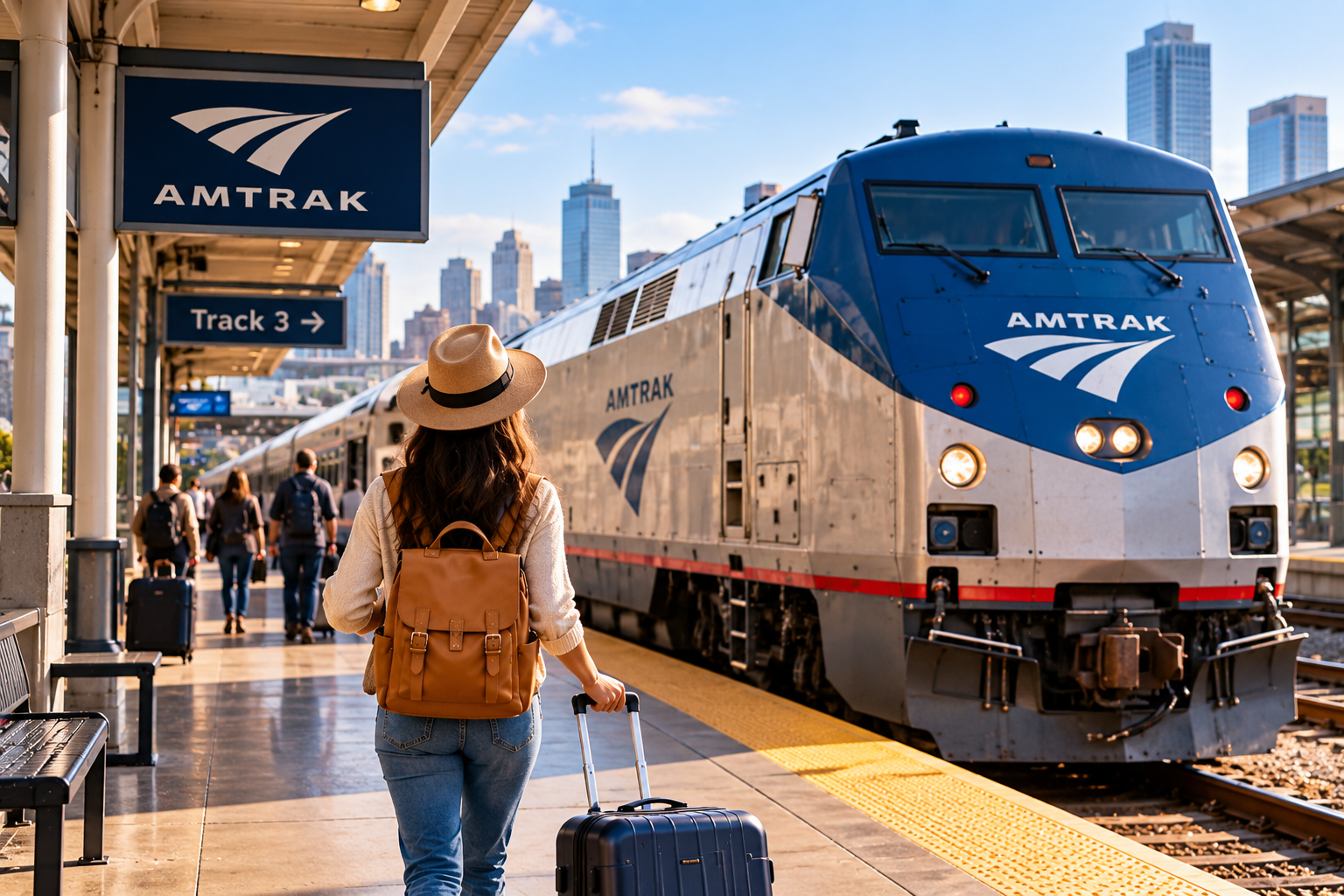
How Does Amtrak Work?
Amtrak operates intercity passenger rail services connecting cities and communities across the United States.
The basic travel process is straightforward.
You select your departure and destination stations, choose a travel date, review available trains and accommodations, and purchase a ticket.
On the day of travel, you arrive at the station, check the departure information, wait for boarding instructions, and board the appropriate train.
Once onboard, the conductor may scan or verify your ticket.
The exact experience varies depending on the train, station, route, and accommodation you have booked.
A short regional journey can feel quite different from an overnight long-distance trip.
Choose Your Departure and Destination Stations
The first step in learning how to ride Amtrak is choosing the correct stations.
Do not search only by city name and assume there is one station serving the entire area.
Some metropolitan areas have multiple rail stations, and certain trains may serve different locations.
Before booking, check:
- Departure station
- Destination station
- Station address
- Departure time
- Arrival time
- Total journey duration
- Connections, if applicable
Also consider how you will reach the departure station and travel from your arrival station to your final destination.
Station location can make a major difference to the overall convenience of your trip.
Before finalizing your journey, you can also learn how to book train tickets online and compare your rail travel options.
Book Your Amtrak Ticket
Once you have selected your route, the next step is booking your ticket.
Review the available departure times, fare conditions, and accommodation options carefully.
Depending on the train, travelers may find options such as Coach, Business Class, First Class, or private sleeping accommodations.
Not every option is available on every route.
Prices can also vary based on travel date, demand, train, fare type, and accommodation.
Booking earlier can provide more choices, particularly for popular travel dates and accommodations.
Amtrak generally allows reservations well in advance, so travelers with fixed plans do not necessarily need to wait until close to departure.
Before purchasing, confirm the passenger information, stations, travel date, and itinerary.
Travelers who want additional booking guidance can also review this Amtrak train booking guide before choosing their trip.
Save Your Ticket and Reservation Details
After booking, keep your ticket somewhere easy to access.
Many travelers use an electronic ticket on their smartphone.
Before leaving for the station, make sure your phone is charged and your reservation information is available.
Saving an offline copy or screenshot can provide a useful backup.
You should know your:
- Train number
- Departure station
- Departure time
- Destination
- Reservation details
If your itinerary includes a connection, review that information as well.
Having everything organized before reaching the station can make your first Amtrak trip much easier.
Check Your Station Before Traveling
Amtrak stations vary considerably.
A major city station may offer staffed services, waiting areas, food options, lounges, baggage facilities, and other amenities.
A smaller station may offer fewer services.
Before departure, check what is available at your specific station.
Pay particular attention to baggage services if you plan to check luggage because checked baggage is not available at every station or on every train.
You should also confirm parking or local transportation options if needed.
Knowing what to expect before arriving can prevent unnecessary confusion.
How Early Should You Arrive for Amtrak?
For many trips, passengers should plan to arrive at least 30 minutes before scheduled departure.
However, you may need additional time in certain situations.
Arriving earlier can be useful if:
- You need assistance
- You have checked baggage
- You are unfamiliar with the station
- The station is particularly large or busy
- You are traveling during a holiday period
- You need to locate parking
- You have accessibility requirements
Do not plan to reach the station at the exact departure time.
Give yourself enough time to locate the correct departure area and listen for boarding instructions.
Do You Need to Check In for Amtrak?
Amtrak travel generally does not involve the same standard check-in process travelers may associate with airlines.
For many journeys, passengers can arrive at the station with their ticket and proceed according to the boarding instructions.
However, additional steps may be necessary if you are checking baggage or require assistance.
Your station and route can also affect the process.
First-time travelers should follow station announcements, departure boards, and instructions from Amtrak staff.
If you are uncertain where to go, ask a staff member rather than waiting until boarding has nearly finished.
Understand the Amtrak Boarding Process
Boarding procedures vary by station.
At larger stations, passengers may wait in a designated area until the track or boarding gate is announced.
At smaller stations, the process can be simpler.
When boarding begins, have your ticket readily available and follow instructions from station or train staff.
Do not assume every door will be used for boarding.
Depending on the train and station, passengers may be directed toward particular cars or boarding locations.
If you have booked a specific accommodation, staff can help direct you to the appropriate area.
Find Your Seat or Accommodation
Where you sit depends on your train and ticket type.
Coach is the standard seating option on many Amtrak trains.
Business Class is available on selected services and can provide additional benefits depending on the route.
Acela uses different class options, while long-distance trains may offer private sleeping accommodations.
Some services use assigned seating, while other boarding situations may involve staff directing passengers to a car or seating area.
Follow the instructions associated with your specific train rather than assuming the process will be identical to a previous journey.
If you cannot find your seat or accommodation, ask a crew member for assistance.
What Luggage Can You Bring on Amtrak?
Amtrak has baggage rules covering personal items, carry-on luggage, and checked baggage.
A common general allowance includes one personal item and two carry-on bags, subject to applicable size and weight limits.
Checked baggage is available on eligible routes and at participating stations, but it is not universally available.
This distinction is important for first-time passengers.
Do not arrive with luggage expecting to check it without first confirming that your departure and destination stations support the service.
Keep identification, medication, electronics, tickets, and other essential belongings in luggage that remains accessible to you.
Always check current baggage requirements before your journey, particularly if you are bringing oversized or special items.
Where Do You Put Your Luggage on Amtrak?
Carry-on luggage may be stored in designated baggage areas or appropriate onboard storage locations, depending on the train.
Smaller personal belongings should be kept organized and should not obstruct aisles, seats, or other passengers.
Avoid bringing more luggage than you can reasonably manage.
Even when a bag falls within permitted limits, you may still need to handle it during boarding and departure.
Labeling your luggage with identification is also a sensible travel precaution.
For a smoother journey, keep frequently used items in a smaller personal bag instead of repeatedly opening your main suitcase.
What Should You Bring on Amtrak?
Your packing list depends on the length of your trip.
For a short journey, basic essentials may be enough.
For a longer trip, consider bringing:
- Ticket and identification
- Phone
- Charging cable
- Medication
- Water
- Snacks
- Headphones
- Comfortable clothing
- Light jacket
- Personal hygiene items
- Offline entertainment
If you are taking an overnight train, a travel pillow, eye mask, extra socks, and other comfort items may also be useful.
Download important files, movies, music, or books before departure so you have access even when internet connectivity is limited.
Can You Bring Food on Amtrak?
Passengers can generally bring personal food and beverages for consumption at their seat or private sleeping accommodation, subject to applicable rules.
This can be particularly useful on long journeys.
Some trains also provide food and beverage service, although the available options depend on the route and train.
Bringing a few snacks and water can help you stay comfortable if your preferred food is unavailable.
Choose food that is easy to store and eat without creating unnecessary mess for other passengers.
Does Amtrak Have WiFi?
Free basic Wi-Fi is available on many Amtrak trains, but not every service offers it.
Internet quality can also vary while the train is moving.
Standard onboard Wi-Fi is generally better suited to activities such as checking email and basic web browsing than high-bandwidth streaming.
If you plan to work during your journey, download important documents beforehand.
The same applies to entertainment.
Download movies, podcasts, music, or books before boarding instead of depending entirely on onboard internet access.
Can You Charge Your Phone on Amtrak?
Electrical outlets are available on many Amtrak trains, making it possible to charge phones, laptops, and other personal devices.
However, equipment and amenities can vary.
Travelers should board with important devices already charged.
A portable power bank can provide additional backup, particularly on a long-distance journey.
Keep charging cables in an accessible part of your personal bag rather than inside luggage stored away from your seat.
What Is Amtrak Coach Like?
Coach is a common choice for Amtrak passengers.
It is suitable for many short and long-distance journeys and generally provides comfortable seating with more freedom to move around than travelers may associate with some other forms of transportation.
The exact seat design and onboard environment depend on the train equipment.
If you are traveling overnight in Coach, consider bringing additional comfort items such as a travel pillow, eye mask, and lightweight layer.
For a short daytime trip, you may need very little beyond your normal travel essentials.
What Are Amtrak Sleeping Accommodations?
Private sleeping accommodations are available on many long-distance trains.
Options can include Roomettes and Bedrooms, although the exact accommodations depend on the train.
Sleeping accommodations are designed for travelers who want additional privacy and comfort during longer or overnight journeys.
They cost more than standard Coach seating, and availability can be limited.
If a private room is important to your trip, booking earlier can provide more opportunity to find the accommodation you want.
Review what is included with your particular room before packing.
What Can You Do During an Amtrak Journey?
Train travel gives passengers several ways to spend their time.
You might:
- Read
- Work
- Listen to music
- Watch downloaded entertainment
- Talk with your travel companion
- Eat
- Rest
- Enjoy the scenery
On longer journeys, being able to change activities can make the trip feel more comfortable.
When moving through the train, use appropriate handholds because trains can shift while in motion.
Always follow crew instructions and onboard safety guidance.
What Happens When You Reach Your Destination?
As your destination approaches, listen for announcements and begin gathering your belongings.
Do not wait until the train has completely stopped to start looking for your phone, jacket, charger, or luggage.
At certain smaller stations, passengers may be instructed to exit from a particular car or door.
Follow crew directions.
Before leaving your seat, check the surrounding area carefully for personal belongings.
Once off the train, follow station signs toward the main station area, local transportation, rideshare pickup, parking, or your next connection.
First-Time Amtrak Travel Tips
A few simple habits can make your first journey much easier.
Confirm your station before leaving home and arrive with enough time before departure.
Keep your ticket and identification accessible.
Pack light enough that you can manage your luggage comfortably.
Bring water, snacks, headphones, and a charger.
Download entertainment and important documents before boarding.
Listen to station and onboard announcements rather than assuming the process will be the same at every stop.
Most importantly, ask a staff member when you are unsure about boarding, seating, luggage, or your destination stop.
Common First-Time Amtrak Mistakes
One common mistake is arriving too close to departure.
Another is assuming checked baggage is available at every station.
Travelers may also pack too much, forget to charge their phones, or depend completely on onboard Wi-Fi.
Another mistake is failing to verify the station address.
Large cities may have multiple transportation terminals, so knowing the exact departure location is essential.
For long-distance journeys, passengers sometimes underestimate how much comfort items matter.
A few well-chosen essentials can make an overnight trip much easier.
Is Traveling on Amtrak Easy for Beginners?
For most travelers, the process is relatively straightforward once they understand the basic steps.
Book the correct route, review your station information, prepare your luggage, arrive with enough time, follow boarding instructions, and keep your ticket accessible.
You do not need to understand every detail of train travel before your first journey.
Your specific route and station information are more important than trying to memorize the entire Amtrak system.
Prepare for the journey you actually booked and ask for assistance when needed.
Explore more Amtrak travel information to plan your next rail journey across the United States.
Final Thoughts
Learning how to travel on Amtrak is mostly about understanding what happens before departure, at the station, during boarding, and once you are onboard.
Start by choosing the correct stations and booking a ticket that matches your schedule and comfort preferences.
Before departure, review the baggage rules, station facilities, ticket details, and available onboard amenities.
Arrive with enough time, keep your essential belongings accessible, and follow staff instructions during boarding.
For longer journeys, prepare snacks, entertainment, charging options, and comfort items in advance.
Once you understand these basics, traveling by Amtrak can become a straightforward way to explore destinations across the United States.
Frequently Asked Questions
How do you travel on Amtrak for the first time?
Choose your departure and destination stations, book your ticket, review the station and baggage information, arrive before departure, follow boarding instructions, and keep your ticket accessible during the journey.
How early should I arrive for Amtrak?
For many journeys, arriving at least 30 minutes before departure is recommended. Allow additional time if you need baggage services, assistance, parking, or are traveling through a busy station.
Do you need to check in before an Amtrak train?
Most Amtrak journeys do not use the same standard check-in process as airlines. Additional steps may apply for checked baggage or special assistance.
Can I use an electronic ticket on Amtrak?
Yes, electronic tickets are commonly used. Keep your phone charged and make sure your ticket is easy to access when needed.
Can I bring luggage on Amtrak?
Yes. Amtrak allows personal and carry-on baggage within applicable limits, while checked baggage is available on certain trains and at eligible stations.
Can you bring your own food on Amtrak?
Passengers can generally bring personal food for consumption at their seat or private accommodation, subject to applicable policies.
Does Amtrak have WiFi?
Free basic Wi-Fi is available on many Amtrak trains, but availability and connection quality vary by service and location.
Can you charge your phone on Amtrak?
Many Amtrak trains provide electrical outlets, although onboard equipment can vary. Bringing a charged power bank is a useful backup.
Can you sleep on Amtrak?
Yes. Passengers can travel overnight in Coach, and many long-distance trains also offer private sleeping accommodations such as Roomettes and Bedrooms.
Is Amtrak good for first-time train travelers?
Amtrak can be straightforward for beginners when travelers review their ticket, station, baggage rules, boarding process, and onboard amenities before departure.